



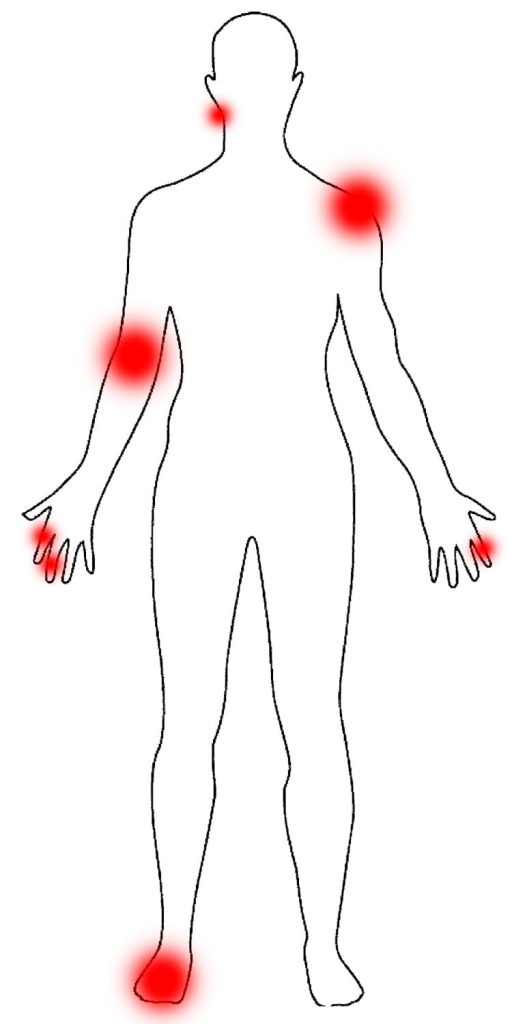
Three weeks ago, I took my first dose of Methtrexate (MTX), a chemotherapy agent, and an immuno-suppresant drug, after months of persistent, debilitating chronic pain. It had begun in my foot early spring. By the time I started the drug, the pain had spread to my shoulder, elbow, multiple fingers, hips, and jaw. In beginning of August, I was diagnosed with Rheumatoid Arthritis after my second set of blood tests came back abnormal.

Rheumatoid arthritis is an autoimmune disease
in which the body’s immune system
which normally protects its health by
attacking foreign substances like bacteria and viruses
mistakenly attacks the joints.
(Arthritis Foundation)
Rheumatoid Arthritis and Chronic Pain
The pain was always worst in the morning, when I first got up, and persisted for hours. On my worse days, I was in tears trying to get out of bed or brushing my hair. Throughout the day, I would be in less pain, but I would always be limping. Or moving around in what I called the “T-Rex Pose,” because I was unable to extend my joints.

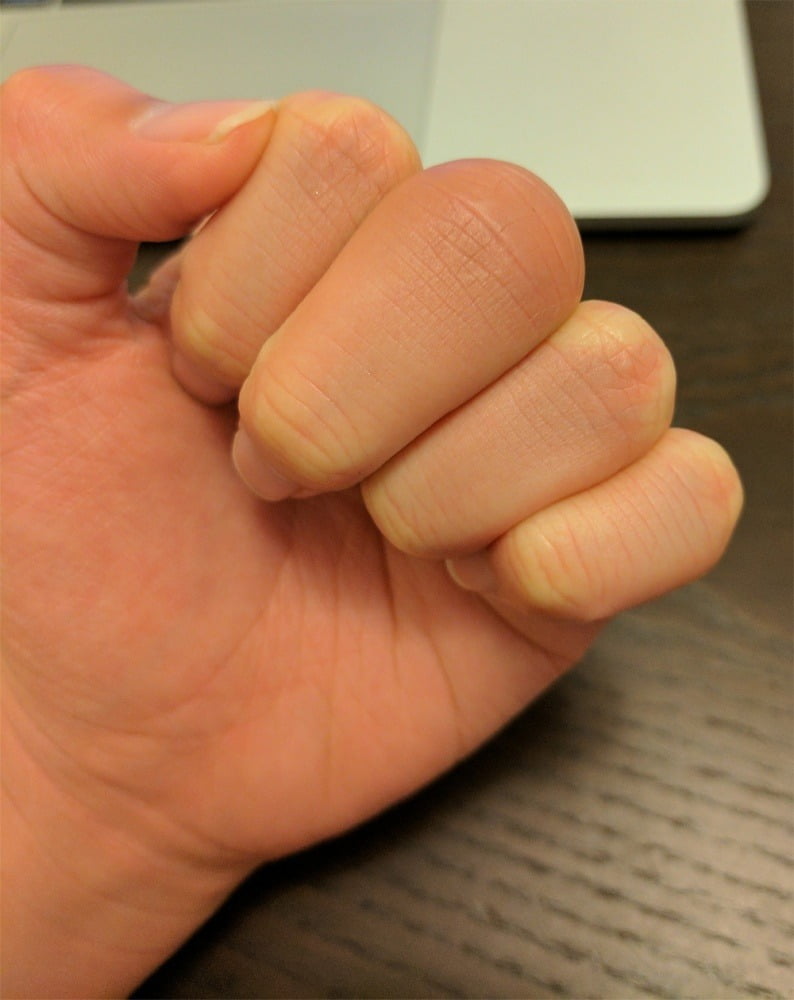
Some days, the swelling in my fingers made it all but impossible to even type on my laptop. The shoulder and elbow pain made it difficult for me to carry anything, even as light as a cellphone. The pain in my foot has been around the longest. It makes my foot swell so much that I can’t fit into most shoes I own anymore.

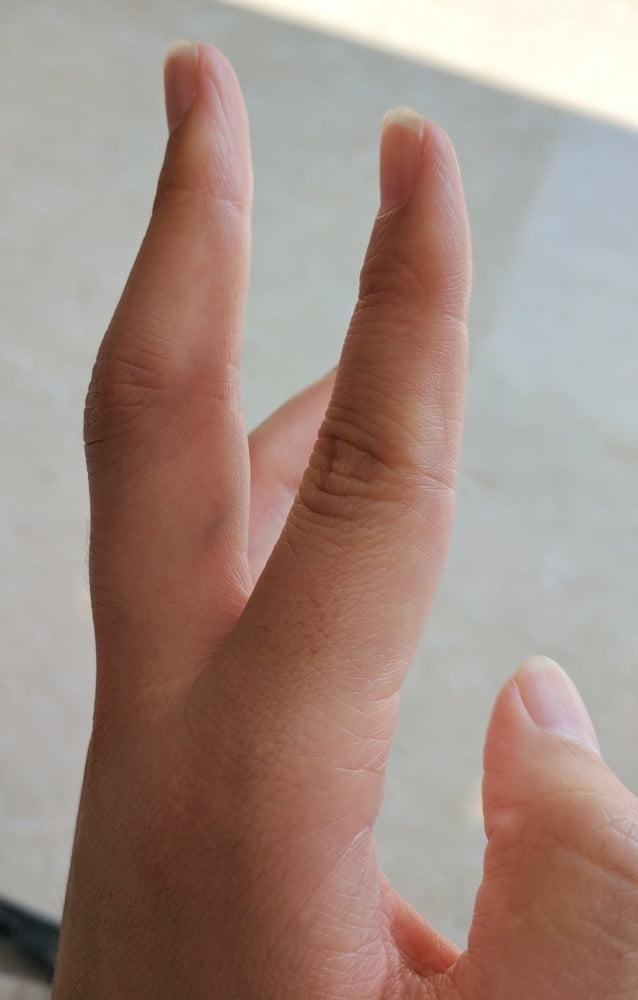
To the left, you can see how one of my affected joints looks, compared to the other non-inflamed joints. It’s almost double in size, and it’s been this way since mid-May.
The middle finger is “straight” in the photo to the right. But it looks like it’s bent because of all of the inflammation. Though the other affected fingers are not as apparent, I have a fairly “fattened” joint on my right index finger. There’s also pain in the stem of the left index finger.
What’s in a Joint?
My Rheumatologist told me that with Rheuamtoid Arthritis, the arthritis attacks the joint closest to your hand and the one in the middle of the finger, but rarely the one at the top of the finger.
It’s pretty remarkable how many things you suddenly struggle to do when just a few of your fingers are out of commission. Cooking (especially the large pans/heavy pots) and cleaning (scrubbing) are nightmares, as are opening lids and containers.
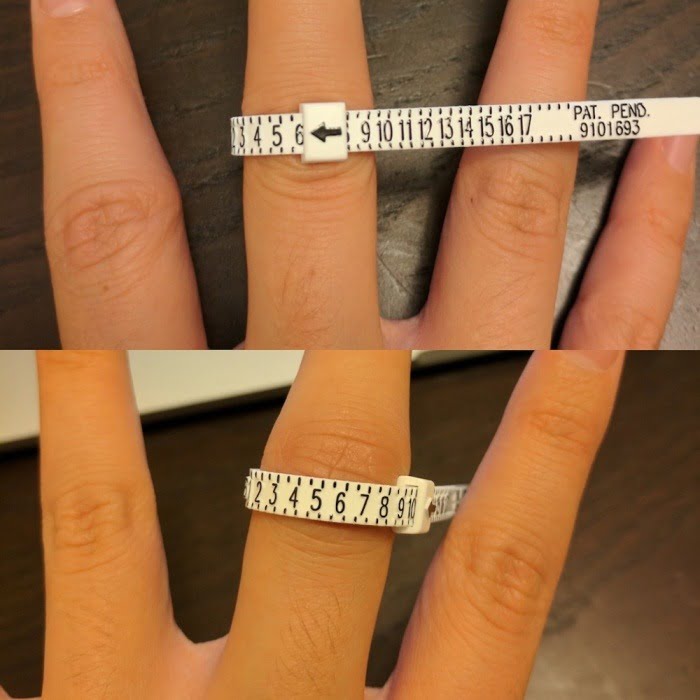
I recently got a Ring Sizer, so I used it to measure my busted joints. The affected joint was a Size 10. The normal one was a Size 6. I hope it’s going to go back to the normal size, along with my other affected joints.

Wait… Isn’t Arthritis For Old People?

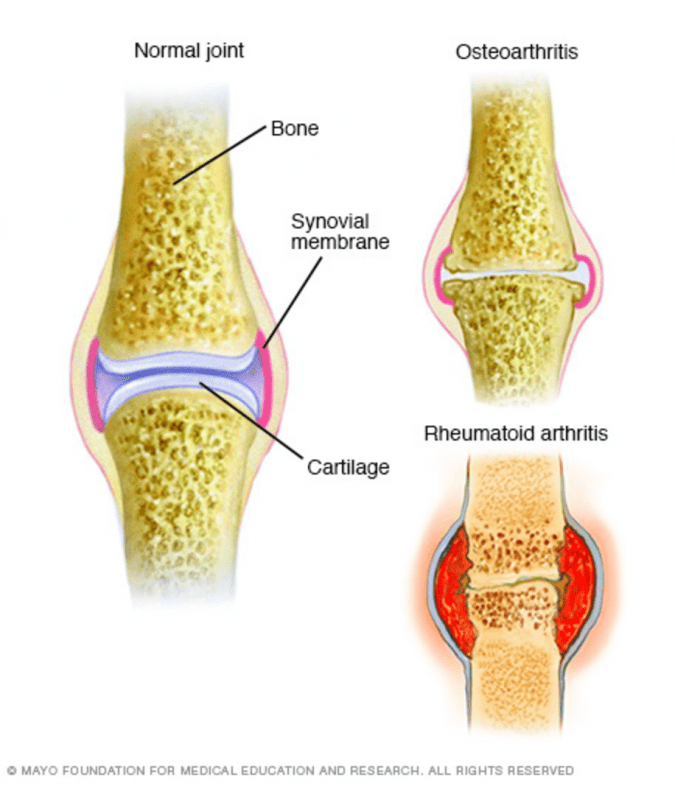
Rheumatoid Arthritis is an Auto-Immune disorder. It happens because of the inflammation of the fluid between the joints, which causes swelling, pain, and potentially eventual erosion of joints. This can happen at any age, though women are 2~3 times as likely to have RA than men.
Osteoarthritis, on the other hand, happens because of wear and tear of use on the joint-caps, which is common with age. So when you are thinking of the “Arthritis Old People Get,” it’s often the “Osteoarthritis,” not the auto-immune disorder.
Because the causes of the joint pain are different, treatment methods and interventions are also different. With RA, you are trying to bring down the immune system’s hyperactivity so the inflammation will go down. With Ostearthritis, you need to find a way to fix your joints. The protective layers have worn away because of use. In both cases, joint damage may be evident after a certain time.
So What’s this Meth…? Met…? Metro???? Thing?
Don’t worry- I thought the same thing. It took me 3 weeks to finally get the name.
Methotrexate (MTX) is considered a DMARD (disease-modifying antirheumatic drug), which is a category of drugs that are used to treat Rheumatoid Arthritis, but are otherwise unrelated. They are tiny and orange, and it’s shocking to think that these little things only barely bigger than Mini-M&M’s could change the course of my life.
In large dosages, MTX is used a Chemotherapy agent for certain types of Cancer. In smaller doses, it is used to treat Rheumatoid Arthritis by acting as an immuno-suppresant (making your immune system less active), and therefore disrupting the process for inflammation. It is the first drug commonly prescribed after a diagnosis of RA, and it helps to ease symptoms such as joint pain, fatigue, swelling/inflammation, and prevent damages to organs and joints.
I don’t know about my organs, but at least my joints are intact, according to the X-Rays I got taken earlier this month, so I am hoping that getting in to Remission will allow me to live damage-free.
Starting the Treatment
To start with, I am taking 6 of these pills every week (I arbitrarily picked Thursdays, so it’s #MTXThursdays from now on… LOL!), and daily dosages of Folic Acid. According to my Rheumatologist, the Folic Acid is for the mouth ulcers that come from taking MTX due to lack of Folic Acid absorption (and totally not for the “stomatitis, gastrointestinal intolerance, bone marrow toxicity, and abnormal liver function tests” that he conveniently forgot to mention).
Because it’s such a strong drug, it’s one of those things with pages upon pages of caution tapes, but for now, I want to focus on getting into Remission so that I can start managing my lifestyle more holistically to prevent relapses. It could cause serious damage to lungs, kidneys, livers, etc., but the most troublesome side effect is the negative effect it has on pregnancy. I most certainly cannot get pregnant on this drug, because it will cause severe deformities in the child.
As a matter of fact, apparently it’s used as an Abortion Drug. So if I were to look into having a family with children in the future, I am going to have to do a lot of shifting and planning, including stopping this drug 3-6 months before my pregnancy (which, of course, would put me in danger of relapse).
The Half-Year Struggle for a Diagnosis
An autoimmune disorder, rheumatoid arthritis occurs
when your immune system mistakenly attacks your own body’s tissues.
(Mayo Clinic)
“You’re Making It Up For Attention.”
The first doctor I went to basically told me that he thinks I am lying about my pain, because he can’t “see any inflammation” except in my finger. The only thing I wanted to say back to him was, “If this is all made up, please please convince me that it’s not real so I can stop being in so much pain!”
He ran the first set of blood tests only because of the inflamed finger, which he couldn’t figure out. And he wrote a prescription for an X-Ray of all the affected joints after my blood test came back positive for abnormalities, but still “only because of that finger; I don’t really think there’s anything wrong with you.”
My right elbow no longer can straighten all the way. My Rheumatologist felt around the joint, and told me that the reason why I couldn’t straighten it is because there is fluid between the joints from the arthritis inflammation. That just blew my mind.
The first doctor I went to pushed it around, and said, “Yeah, but I can straighten it when I pull on it.” YEAH. THAT HURTS. I can go up to maybe 160 degrees before it starts hurting, which I think is an improvement from my worse days, when I couldn’t get it more than 45 degrees open from the inflammation and pain.
Getting the Second Opinion
I took my abnormal blood test result and went to another doctor, whose response was, “Oh, honey… You are at the wrong doctor…” But she promised to get me in to see the right doctor, and true to her word, once my second set of blood tests came back with extremely elevated numbers, she immediately got me into a rheumatologist’s office for the same week. (Appointments are impossible to get in this industry. The first one I tried was a 3 month wait, another one I tried to get does not have an opening until November.)
With my X-Rays and blood test results, I went to see the Rheumatologist in Washington Heights, 2 months after my initial plea to the original doctor to find out what was happening with me. The pain made me want to just die some days, but I’m glad I’m finally diagnosed, and I’ve started a treatment.
The worst part wasn’t the pain, but rather, the rapid loss of mobility and progression of the “whatever it is” throughout my body. I didn’t know what it was, so it was just a scary, mysterious “thing” that was taking over my body, one joint at a time. And my first doctor didn’t do anything to help me find the answers. Now that I know what it is, I feel much better, and much more able to look into the future, even though I know it’s chronic, and there’s no “cure.”
Usually It Takes Longer!
I’m actually pretty blessed in that my diagnosis only took a few months. The average time it takes for diagnosis for Rheumatoid Arthritis is 1-3 years! Many times it has to do with the fact that Rheumatoid Arthritis is a mostly-female-afflicting disease, and many doctors do not take our pain seriously.
#ButYouDontLookSick!


Socially the most difficult part about having a Chronic Illness and Invisible Disability is that most people don’t fundamentally “get” the concept that I am never going to “Get Better” or be “Cured.” This is life long, just like my Brain Injury is life long. I just have to thrive despite the struggles, make accommodations and modifications. There are better days, and there are worse days. Because it’s invisible, if I am “Acting Healthy,” people assume I am all better. I’m not. I just have extremely high pain tolerance (hello, getting head sliced open and stapled with 78 staples!)
When I share my story about my craniotomy, the most common response is, “…But… You’re all better now, right?” No. I’m not “All Better.” My journey is life-long, and I’ll never be “cured.” I just look “Completely Normal” because of the accommodations and modifications I make in my life in order to appear so. But every day is a struggle, and now, with added physical disabilities, it’s even more so. Just because I’m walking around, working and chatting and laughing, doesn’t mean my Rheumatoid Arthritis and the Chronic Pain suddenly disappeared. I’m just at the “low tide” instead of a flare. It’s just not as bad as it could be. And besides, no one wants to be around someone who’s constantly complaining about pain, right?
Some more Clinical Jargon
The below few paragraphs are taken directly from Johns Hopkins Arthritis Center’s “Clinical History.” I’ve bolded parts that are relevant to my case.
Rheumatoid Arthritis Symptoms
The typical case of rheumatoid arthritis begins insidiously, with the slow development of signs and symptoms over weeks to months. Often the patient first notices stiffness in one or more joints, usually accompanied by pain on movement and by tenderness in the joint. The number of joints involved is highly variable, but almost always the process is eventually polyarticular, involving five or more joints. Occasionally, patients experience an explosive polyarticular onset occurring over 24 to 48 hours. Another pattern is a palindromic presentation, in which patients describe swelling in one or two joints that may last a few days to weeks then completely go away, later to return in the same or other joints, with a pattern increasing over time.
Joints Affected
The joints involved most frequently are the proximal interphalangeal (PIP) and metacarpophalangeal (MCP) joints of the hands, the wrists, and small joints of the feet including the metatarsophalangeal (MTP) joints. The shoulders, elbows, knees, and ankles are also affected in many patients. The distal interphalangeal (DIP) joints are generally spared. With the exception of the cervical spine, the spine is unaffected.
Nonspecific Symptoms
Nonspecific systemic symptoms primarily fatigue, malaise, and depression, may commonly precede other symptoms of the disease by weeks to months and be indicators of ongoing disease activity. Fatigue can be an especially troubling feature of the disease for many patients. The pattern of symptoms may wax and wane over the course of a day and even from one day to the next. Sometimes “flares” of RA are experienced as an increase in these systemic symptoms more than discrete joint swelling or tenderness. Fever occasionally occurs and is almost always low grade (37° to 38°C; 99° to 100°F). A higher fever suggests another illness, and infectious causes must be considered, especially in patients who are taking biological therapies and immunosuppressive medications.
Morning stiffness, persisting more than one hour but often lasting several hours, may be a feature of any inflammatory arthritis but is especially characteristic of rheumatoid arthritis. Its duration is a useful gauge of the inflammatory activity of the disease. Similar stiffness can occur after long periods of sitting or inactivity (gel phenomenon). In contrast, patients with degenerative arthritis complain of stiffness lasting but a few minutes.
So… What Now?
Disability is higher among patients with rheumatoid arthritis with
60% being unable to work 10 years after the onset of their disease.
(Johns Hopkins Arthritis Center)
I disclosed to my manager, director, and HR few days after my diagnosis. I explained the disorder, the treatment, and the symptoms of both the treatment and the disorder itself. Because of the toxicity of the drug, I will have fatigue, mouth sores, upset stomach, and affected organs. Because of the RA, I would be in a lot of pain. There will be waves of “flares” and “good days” that are still mostly unpredictable.
Permanent Disability?
I had to accept that there is likelihood I will be unable to work after a bad bout of RA. That I may become completely physically disabled, as opposed to temporarily. There is a limit to how much pain and inflammation I can work through. And a limit on how much drug fatigue I could take. But we are working together to figure out ways to lessen the loads so I can continue working. Even while giving my body the rest it needs to fight the inflammation and the disease.
We’ve established a Work From Home schedule of Wednesdays/Fridays for start. I’m in the process of setting up a “home office” in my apartment. My manager and director checks up on me daily, to see how I’m doing or how I’m feeling. Thankfully, my type of work is such that I can work from anywhere if needs be. So I still have options even if I’m unable to physically take myself to the office anymore.
I want to continue going to the office for as long as I can.
As much of a pain my 2 hours-a-day commute is, I know I’ll miss it when I can’t anymore. But I also need to focus on going into remission so that I can continue functioning as independently as possible.
Sick Again
Mostly, it’s kind of like, “Oh… This again…” after my battle with Arteriovenous Malformation, Seizure Disorder, Craniotomy, and Brain Injury. However, it’s a lot different in that:
- I’m no longer a student, and must work
- I must work because otherwise I won’t have insurance
- I must work because otherwise I can’t pay for my medical bills
- I don’t have anyone to help me make/go to appointments
- I don’t have anyone to ask questions and take notes at appointments while I sit there with a brain fog
- I don’t have anyone to help me manage the “administrative works” of making sure bills are paid
- I have no one to take care of me when I physically cannot do my daily tasks
- At the end of the day, if I am upset, I am in my bed alone to cry
I guess this is just what growing up means! I’m glad I had the previous experience as a student so I’m much better prepared for this round of battles.
I just got a $800 bill from my first Rheumatologist appointment. I’m trying to balance scales to keep on affording my medical bills without dipping into cash (instead of HSA). The good/bad news is, I am only $19 from my annual deductible. So after that, I only have to pay 20% of the bill… Yay?
I guess the amount of money I’m saving from the 1 Paycheck Challenge is going to come in handy soon!
So, That’s My New Journey
I hope you guys are having a better summer than I am! I’m brainstorming ways to accommodate and modify my life. There must be ways I can continue to have a stable income, goals, plans, and a future. If I can beat Brain Injury at its game, I can beat an Autoimmune Disorder!
Have you had any recent health issues? Do you have any meditation/relaxation rituals or resources you can recommend me to start my journey to ZEN? (Because stress = biggest trigger for a flare!)